Showing posts with label setting. Show all posts

Friday, March 29, 2013

What's in a setting?


In fiction, authors use details of setting to define location and character, drawing on readers' knowledge and sometimes cliched impressions about the elements they use. Location and time, for instance, implies climate and sometimes draws on stereotypes of the people living there. Readers might automatically think of freewheeling partygoers in New Orleans, violent criminals and their victims in Chicago, or wealthy retirees, drug lords and Cuban expatriates in Miami.

Beautiful mansions, modest homes and shoddy tenements in whatever location tell readers much about their inhabitants. A character's chosen surroundings can either solidify stereotypes of who he is (a hot, bachelor lawyer with an obviously decorator-done condo that looks like a seduction pad) or a detail that stands away from that stereotype (perhaps a faded, framed photo set unobtrusively on the credenza beside his desk, of a little boy in tattered clothes, standing next to a woman bent over in a strawberry field).

Like the Rolex on his wrist, his custom-tailored suits, his yacht and his gleaming red Ferrari, this hero's condo tells the reader he has achieved success and wealth. The lone personal looking item, in this case a picture, hints that he has known poverty and makes the reader wonder what shaped him into what he is today.

Natural phenomena in settings often punctuate or trigger tumultuous emotions. Is a character apprehensive? Afraid? Uncertain? Or even as wild as the storm? Many times in romance, these feelings in characters will be accompanied by a roll of thunder...crackling lightning in an otherwise black night sky...a burst of hailstones--or a blizzard with snow falling so fast that it seems the lovers may be buried under its frozen depth.

I've pulled an example of using nature to heighten character emotion from each of my Lawyers in Love series books, which I've been revisiting as I write a new, connected series, Courthouse Connections, which I hope will be completed by the end of 2013.

These books can also be bought in two print collections, THE DEFENDERS and THE PROSECUTORS. All of my books are available from Ellora's Cave, AmazonBarnes and Noble, Sony, All Romance EBooks, Kobo and other authorized online booksellers. Print ones are also available through LSI and Createspace.

"Waves rocked the boat. Thunder rolled. She tightened her hold on his hard-muscled torso. He would keep the world at bay, keep her safe..." (In His Own Defense)


"Damn it, he shouldn’t have to keep reminding himself every few minutes that he had no business lusting after what he could no longer have. As if in warning, the thunder clapped again, louder this time.
"Andi shuddered, a strangely sensual motion that contrasted with the fierceness of the storm. “You know, I’m afraid of lightning. Always have been. I wish…" (Bittersweet Homecoming)

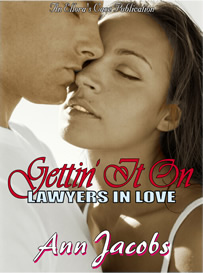
"Sensation sizzled through her brain, the heat of the day bringing sweat up on her brow. Mild heat, though, compared with the fires Craig kindled inside her..." (Gettin' It On)

"For a long time he held her. Shivered with her while the wind pummeled their shelter, reminding him of the danger. Not only that which threatened them, but that which promised to consume him if he gave his raging emotions free rein. If he took her, claimed her now the way he'd been too young and green to take her years ago." (Eye of the Storm)

Conversely, authors will often set the resolution of conflict or its lusty aftermath on a sunny day at the beach, a riverbank with the river's sometimes rushing water running lazily by contented lovers--or a cool evening inside, perhaps in front of a warm and inviting fireplace.  heirloom quilt.


So... There's a lot of emotion an author can show readers by setting. Setting includes not only physical surroundings but also acts of nature that can illustrate the depths of characters' emotions. There's a whole lot to the settings in which authors place their characters.

Ann Jacobs

http://annjacobs.net

"Like" my page on Facebook

Follow me on Twitter


Sunday, April 29, 2012

A Hard-Learned Lesson

You know, some situations just don’t lend themselves to kink. I learned this recently, the hard way.

I write erotic books for a living, so it should make sense that I’d be able to heat up a sensual category romance for reissue. It DID make sense with four of my five New York-published books, but the process just wouldn’t work for the fifth one, no matter how many weeks/months I spent trying to turn it into an erotic romance.
 
At first I didn’t understand why. The hero and heroine enjoyed plenty of hot, imaginative sex, way more than in most category romances. No, there were no ménages, BDSM scenes or kinky dream sequences, but that has been the case in several of my better selling, award-winning original erotic romances, as well as in my four previously revised reissues.
 
I originally proposed the book that just wouldn't turn erotic for Berkley’s limited “Quilting” series, though it was published by Kensington in its short-lived Bouquet line. The quilt-maker heroine was too innocent. The hero, a self-made millionaire seeking to rediscover his roots, was Alpha in the bedroom but a pussycat everywhere else. Worse, the story premise and setting didn't lend themselves to erotic romance. I thought about adding some kinky sex between the hero and his former fiancée…creating a hot, dream sequence between the heroine and her dead fiancé in which she didn’t wait for a wedding that never happened…making the heroine sexually repressed until the hero takes control, as in BDSM light. None of these options made sense for the characters or their worlds.

This wasn't the type of book I've been writing over the past few years. Still, I liked the story and wanted readers who missed it during its brief time in a poorly distributed category line. I'd spun wheels revising it, getting  rid of a lot of problems I hadn’t recognized eleven years ago when I first wrote the book. Because I believe my readers expect my sex scenes to be graphic and detailed, I beefed them up but tried to stay within what I thought Althea and Jared actually would do. 

The result is MOUNTAIN HEAT, a very sexy conventional romance with a folksy tone befitting a country quilt-maker and a guy searching for his long-lost roots, coming soon from Ellora's Cave. I hope  readers won’t be disappointed that the story’s not quite as sizzling as most of my more recent books. I just may write a couple more super-hot but not exactly erotic romances because I occasionally like the one man, one woman scene, even though it seems a little old-fashioned in a romance world of ménage a trois, voyeurism, BDSM, shapeshifting, and so on.

What do you all think? Do you sometimes go for erotic romance "Light", or does your taste always run more toward the no-holds-barred, completely uninhibited tales that leave you panting for your guy/toys/whatever more than sighing over the happily-ever-after conclusion of lovers whose lust is tempered by conventional, vanilla love?
I'll be picking a winner at the end of the month from all the comments posted here. Prize will be a download of the winner's choice of any of my published books, to be announced on Twitter and my Facebook page.
Ann Jacobs
Follow me on Twitter: @authrannjacobs


Wednesday, January 18, 2012

IS YOUR SETTING ANOTHER CHARACTER?

Location. Setting. Why is it so important to our story? It seems obvious in some cases. In others, there could be a 'hidden' agenda. It can actually become another character.

Let's take a look, first, at the importance of setting to our genre, or sub-genre.
Fifty years ago, the choices were limited. Regencies and Westerns were prevalent sub-genres in the historical category, and mysteries and detective stories captivated the 'contemporary' nook. Science fiction was still relatively uncharted.
The setting of a novel was a definitive device, separating the genres as clearly as any other element of writing.

The glittering ballrooms and colorful gowns and jewels whisked historical romance readers away to faraway, exotic locales. Sagebrush, cactus, and danger awaited heroes of the western genre, a male- dominated readership.

But something odd happened as time went by. The lines blurred. Rosemary Rogers combined the romance of exotic places with the danger of an action plot, and an unforgettable hero in Steve Morgan that, had a man picked up 'Sweet Savage Love' and read it, he certainly could have identified with.

By the same token, the male-oriented scenery accompanied by the stiff, stylized form of western writers such as Owen Wister (The Virginian) and Zane Grey (Riders of the Purple Sage, The Last Trail) gave way to Louis L'Amour (Conagher, the Sackett series) and Jack Schaefer (Shane, Monte Walsh).

Why is the evolving change in description of location so important? In older writings, many times the location of a novel was just where the story happened to take place. Often, the plot of the story dictated the setting, rather than the two forming any kind of 'partnership.'

But with the stories that came along later, that partnership was strengthened, and in some cases, location became almost another character in the plot.
Take, for example, Louis L'Amour's 'Conagher.' As he describes the heroine's (Evie) dismal hopelessness at the land her husband (Jacob) has brought her to, we wonder how she will survive. Yet, Jacob has plans, sees the possibilities that Evie cannot, or will not see. The underlying message is, "The land is what we make of it."

As the story continues, she begins to appreciate the beauty of the prairie, while acknowledging the solitary loneliness of her existence. She plants a garden, nurturing the plants, and gradually she sees the farm being shaped into a good home from the ramshackle place she'd first laid eyes on.

The land is beautiful, but unforgiving. Her husband is killed in a freak accident, and for months she doesn't know what has happened to him. She faces the responsibility of raising his two children from a previous marriage alone.

In her loneliness, she begins to write notes describing her feelings and ties them to tumbleweeds. The wind scatters the notes and tumbleweeds across the prairie. Conagher, a loner, begins to wonder who could be writing them, and slowly comes to believe that whomever it is, these notes are meant for him.

At one point, visitors come from back East. One of them says to Evie something to the effect of "I don't know how you can stand it here."

This is Evie's response to her:
"I love it here," she said suddenly. "I think there is something here, something more than all you see and feel…it's in the wind.

"Oh, it is very hard!" she went on. "I miss women to talk to, I miss the things we had back East–the band concerts, the dances. The only time when we see anyone is like now, when the stage comes. But you do not know what music is until you have heard the wind in the cedars, or the far-off wind in the pines. Someday I am going to get on a horse and ride out there"–she pointed toward the wide grass before them–"until I can see the other side…if there is another side."

The land, at first her nemesis, has become not only a friend, but a soulmate. If that's not romance, I don't know what is.

Think of your own writing projects. What importance do you give setting in your description, plot, even characterization? Within 40 pages of 'Conagher', we understand that the land, with all its wild beauty and dangers has become enmeshed in Evie's character. She can't leave it, and it will never leave her.